
Friday, 14 October 2011
Drop In
Just because there's an 'in' in involved doesn't mean you can drop it when it's needed elsewhere in the sentence:


Monday, 10 October 2011

Saturday, 8 October 2011
Not as Good as it Gets


Saturday, 1 October 2011


Saturday, 24 September 2011
Heavens to Murgatroyd
I agree with the comment on this picture (the picture's quite flattering though).
I Had a Good Job But I Left
I may be revealing a streak of incipient racism, but it seems to me that the person who wrote this caption may have confused their left with their right:


Friday, 16 September 2011
One Day
I loved the novel One Day but it was a touch and go thing at the start. The sloppy editing almost made me throw the book across the room, although in the end David Nicholls's excellent writing won out.
1. My biggest bugbear was the idiotic and repeated misuse of the word 'onto':
a. were they planning to climb on the roof of the pub:

b. was he planning to lie on a map of India:
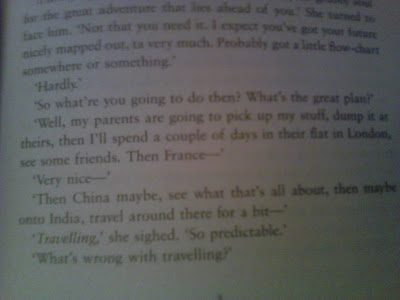 c. 'I can rely onto' - hmm, sounds just that bit too clingy:

2. Then there was the editorial decision to replace 'all right' with 'alright', (but this I know is a losing battle; alright is winning, but I still think it's wrong):


3. There were also the irritating departures from grammar as we know it:
a. 'everyone seem to know':

b. "Yes, that's that what I meant":

4. Finally, there was the parenthetic dash that was left dangling, left permanently without its partner:

1. My biggest bugbear was the idiotic and repeated misuse of the word 'onto':
a. were they planning to climb on the roof of the pub:

b. was he planning to lie on a map of India:


2. Then there was the editorial decision to replace 'all right' with 'alright', (but this I know is a losing battle; alright is winning, but I still think it's wrong):


3. There were also the irritating departures from grammar as we know it:
a. 'everyone seem to know':

b. "Yes, that's that what I meant":

4. Finally, there was the parenthetic dash that was left dangling, left permanently without its partner:

Thursday, 15 September 2011
Thursday, 8 September 2011

Tuesday, 6 September 2011
Separate or Unflashy?
Someone on Twitter who goes by the name of Albury Bible Fellowship spotted this in the Sydney Morning Herald:
http://twitter.com/#!/AlburyBF/status/110922350668677120/photo/1/large
Many thanks, Albury, if I may call you that.
http://twitter.com/#!/AlburyBF/status/110922350668677120/photo/1/large
Many thanks, Albury, if I may call you that.
Sunday, 4 September 2011
Let the Punishment Fit the Crime
If you put the word 'death' in a headline, the word 'axed' tends to suggest bloody executions, rather than sackings:


Thursday, 1 September 2011
Ancient Potato
I like the idea of our former Prime Minister sprouting (I've always thought he looked a bit of an ear- and nose-hair kind of man). However, I think the word the author was searching for was actually 'spout':


Enough Articles
Since when did 'enough' take an article:
 And party figures ought to be furious that Ms Jackson chose to refer the Thomson affair, ( I should point out, by the way, that I'm talking about verb tenses rather than principles.)

Miracle in the ACT
These people, whose picture appeared in the Canberra Times, really don't look particularly old, but it seems they have a descendant who participated in World War I:


Friday, 26 August 2011
For the Want of a Comma
The sentence beginning, 'There are no rallies ...' is entirely ambiguous. I imagine that the writer is saying that the reason there are no rallies or complaints is that most men have escaped 'this cultural curse', but, without a comma before 'because', the sentence could just as easily mean that Dior Homme does make size 40 waist jeans, but not because most men have escaped:
 When using 'because' a good rule of thumb is to think about these two sentences: 1. I knew she'd been crying because she looked ugly - in this one her ugliness has provoked her tears. 2. I knew she'd been crying, because she looked ugly - in this, her ugliness is caused by her tears.

Thursday, 25 August 2011

Wednesday, 17 August 2011
Check those Facts
On one page of the Australian yesterday there was this chart, which indicated that all but two of the High Court bench have been appointed by Labor:
 On the opposite page, we were told that 'it is worth remembering a majority of the court - four - were appointed by the Howard government':
 Which is true?


Saturday, 6 August 2011
So True

Wednesday, 3 August 2011


Sack that Sub
Hey Sydney Morning Herald, I don't mean to be rude, but the person who worked on your Murray-Darling article in today's edition made a total hash of the job:


A Clean Energy Future
Is gas a renewable, as this sentence from the federal government's Clean Energy Future advertisement seems to imply:


Commas Make Sense
In Nikki Savva's article in yesterday's Australian, a couple of commas, plus a semi-colon, would have made things clearer:
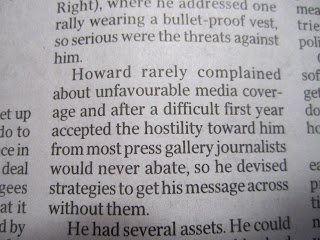
 Today, in the Sydney Morning Herald, there were places where commas were missing:


and others where they really should not have appeared (why is there one after 'Glenn Stevens?):


and others where they really should not have appeared (why is there one after 'Glenn Stevens?):

Subscribe to:
Posts (Atom)